Setting up a business in Dubai means choosing between a mainland licence from the Department of Economy and Tourism (DET) and a free zone licence from one of the emirate's 30-plus free zone authorities, then working through roughly seven mostly online steps. Mainland suits businesses selling directly to UAE customers; a free zone suits international, online, and service businesses that want lower cost and a faster, remote setup.
This guide covers business setup in Dubai for 2026: how the two routes differ after the 2025 rule change that lets free zone companies trade on the mainland, which Dubai free zone fits which business, the real costs, the bank account step that trips up most founders, and the tax position. Figures are current as of June 2026 and sources are listed at the end. For the national overview, see our detailed guide to setting up a business in the UAE, and for the lower-cost neighbouring option, our Sharjah business setup guide.
Why set up a business in Dubai?
Dubai offers the deepest consumer market in the region, the widest choice of free zones in the UAE, and the strongest international banking relationships, in return for higher setup and running costs than Sharjah or the northern emirates. The government's D33 agenda aims to double the size of Dubai's economy by 2033, and the licensing system has been steadily opened up to support that, including the 2021 move to 100% foreign ownership on most mainland activities and the 2025 reform letting free zone companies operate on the mainland.
The practical draw is optionality. Whatever your activity, there is usually a Dubai free zone built for it, plus a mainland route if you need direct local trade. The cost of that optionality is real: a Dubai free zone licence starts from around AED 12,500 for Meydan's standard licence — other Dubai zones such as IFZA, DAFZA, DIFC and ADGM are quote-based, against roughly AED 5,750 in neighbouring Sharjah, and Dubai visas and office space cost more. If your customers and credibility needs justify it, Dubai is the stronger base. If cost control is the priority, weigh the Sharjah route.
Mainland or free zone in Dubai?
Choose a DET mainland licence if you sell directly to UAE customers, want government contracts, or run retail, food, or hospitality. Choose a free zone if your revenue is mostly international, you want 100% foreign ownership at lower cost, or you need a fast, remote setup. This decision sets where you can trade, who regulates you, and how your tax is assessed.
A mainland company is licensed by the DET (formerly the DED). It can trade anywhere in the UAE and internationally, take government work, and hold a visa quota tied to office size. Since 2021, 100% foreign ownership applies to most commercial and professional activities, so a local partner is no longer required for the majority of businesses. Mainland companies must hold a physical office with a registered Ejari tenancy contract.
A free zone company is licensed by the free zone authority, allows 100% foreign ownership, and typically operates from a flexi-desk that banks accept for account opening. The historic limitation was that a free zone licence could not be used to sell directly into the mainland market. That changed in 2025.
The 2025 change: the free zone mainland operating permit
Dubai now lets most free zone companies operate on the mainland without forming a separate mainland entity. Under Executive Council Resolution No. 11 of 2025, effective 3 March 2025, a Dubai free zone company (financial firms in the DIFC are excluded) can apply to the DET for a branch licence or a temporary permit and trade in mainland Dubai under it. The published annual fees are AED 10,000 for a branch licence and AED 5,000 for a temporary permit valid up to six months. The DET issues the list of activities each company may perform, so confirm your activity is eligible before relying on this route.
The reform removes a structural reason to default to a mainland licence. It does not make mainland income tax-free for a free zone company. Income from mainland UAE customers is generally non-qualifying for the 0% free zone rate, so serving local clients can move that income into the 9% band. Treat the licensing decision and the tax decision as two separate calculations.
The mainland versus free zone comparison lays out the trade-offs for your activity.
Dubai's free zones: which one fits your business?
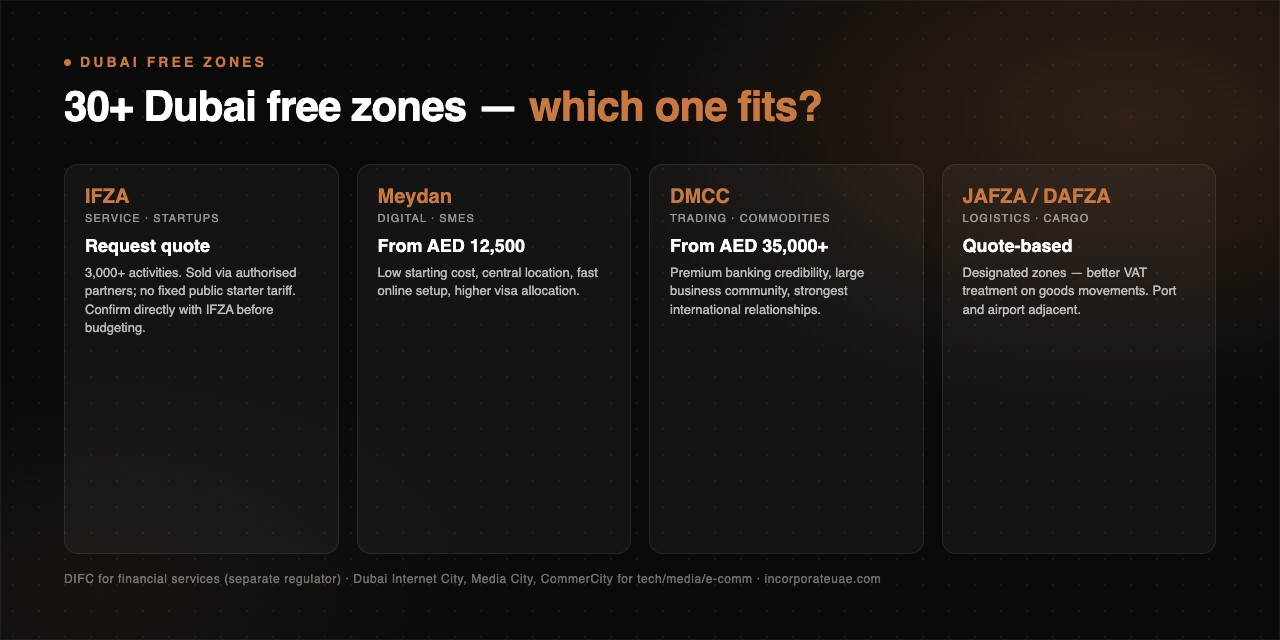
Dubai hosts more than 30 free zones, each with its own authority, fee schedule, and reputation. They are not interchangeable. The headline licence price matters less than matching the zone to your activity, your banking needs, and your visa count. These are the ones most founders actually consider.
| Free zone | Built for | Notes |
|---|---|---|
| IFZA (Dubai Silicon Oasis) | Digital services, consulting, startups wanting a Dubai address at lowest cost | Request quote — IFZA is sold via authorised partners and does not publish a single fixed public starter tariff. 3,000-plus activities available; confirm pricing with IFZA before budgeting |
| Meydan | Digital businesses and startups; centrally located | Low starting cost from around AED 12,500; fast online setup; higher visa allocation |
| DMCC | Trading, commodities, and businesses needing top-tier banking credibility | Higher cost (commonly around AED 35,000+); strongest banking relationships; large business community |
| JAFZA (Jebel Ali Free Zone) | Logistics, manufacturing, import and export | Port access; a designated zone with better VAT treatment on goods movements |
| DAFZA (Dubai Airport Free Zone) | Aviation, electronics, cargo | Beside the airport; designated zone |
| Dubai Internet City (DIC) | Technology and IT | The region's largest IT hub; strong ecosystem |
| Dubai Media City (DMC) | Media, marketing, production | Media-focused community |
| Dubai CommerCity | E-commerce | Designated zone built for online retail and goods movement |
| DIFC | Financial services | Separate regulator; excluded from the 2025 mainland permit |
Two operational points that change the real cost:
- Designated zones. JAFZA, DAFZA, and Dubai CommerCity are designated zones, which gives them more favourable VAT treatment on the movement of goods. If you ship physical products, this matters more than the licence price.
- Banking acceptance. Newer low-cost zones such as IFZA and Meydan are accepted by banks but scrutinised more conservatively than DMCC. If institutional banking credibility is important to you, that is part of what the higher DMCC cost buys. For a deeper breakdown, see our comparison of the major UAE free zones, and use the zone picker to match a zone to your activity.
How to set up a business in Dubai: step by step
- Define your activity. Choose your activity from the DET or free zone activity list. It drives the licence type and any external approvals (food, healthcare, and financial activities need regulator sign-off first).
- Choose your jurisdiction and structure. Decide between DET mainland and a free zone, then the entity type: an LLC on the mainland, or a Free Zone Establishment or Free Zone Company in a zone.
- Reserve your trade name and get initial approval. Reserve a compliant name and secure the authority's no-objection to proceed. On the mainland you usually have around 30 days to pay the licence fee after approval.
- Sign the documents and secure an address. Mainland LLCs sign a notarised Memorandum of Association and register an Ejari office lease. Free zone companies sign standard documents and can take a flexi-desk. See the office and Ejari requirements.
- Pay the fee and collect your licence. Pay and receive your trade licence. Many Dubai free zones issue in three to ten working days, and some offer instant licences. The mainland licensing route sets out the DET document checklist.
- Apply for visas and Emirates ID. Your licence unlocks an establishment card and a visa quota. Each visa runs through an entry permit, medical, Emirates ID, and stamping. The residence visa guide covers eligibility.
- Open a corporate bank account. Budget two to four weeks and prepare for enhanced due diligence. This is the step most founders underestimate, covered next.
Opening a business bank account in Dubai
The bank account, not the licence, is where Dubai setups most often stall. Tier-1 banks (such as Emirates NBD, ADCB, Mashreq, and HSBC) reject a meaningful share of free zone applications on first submission, with reported first-pass rejection rates of roughly 30% to 40%, and newer low-cost zones tend to face more scrutiny. Rejections rarely come with a clear reason, because every application is risk-scored against ownership, activity, and source of funds under Central Bank and anti-money-laundering rules.
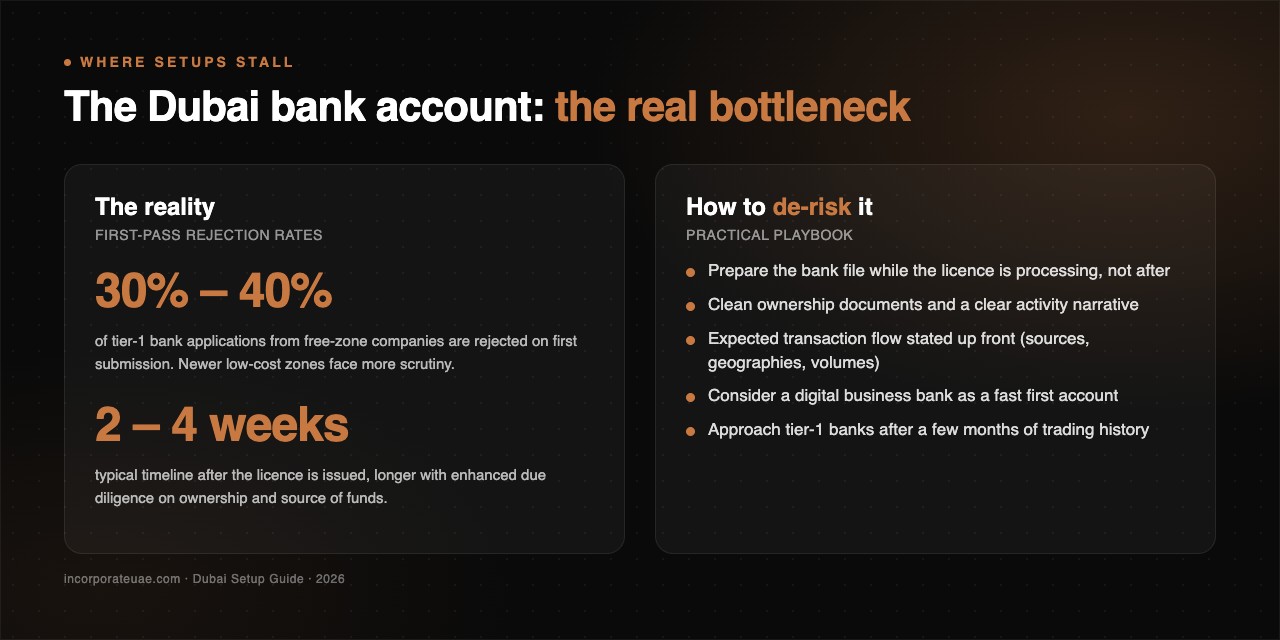
Two practical responses reduce the friction. First, prepare the bank file while the licence is processing, not after, with clean ownership documents and a clear description of your activity and expected transaction flow. Second, where a tier-1 bank is slow or declines, a digital business bank can get you operational quickly, after which you can approach a tier-1 bank with a few months of trading history behind you. Our guide to opening a UAE business bank account as a foreigner covers the documents and the common rejection reasons in detail.
How much does business setup in Dubai cost in 2026?
First-year costs run from around AED 12,500 for Meydan's standard licence to AED 75,000 or more for a mainland LLC with an office and a visa. Budget across four pillars and keep them separate, because the advertised licence price rarely includes the office, visas, or any agency fee.
| Cost pillar | What it covers | Typical Dubai range (2026) |
|---|---|---|
| Licence and government fees | Registration, initial approval, trade licence | From around AED 12,500 (Meydan standard licence) up to AED 35,000+ for premium zones like DMCC; other Dubai zones are quote-based |
| Office or address | Free zone flexi-desk, or a leased mainland office (Ejari) | Flexi-desk included in many free zone packages; mainland office priced on space |
| Visa and Emirates ID | Entry permit, medical, Emirates ID, residency stamping, per person | Around AED 5,500 per person |
| Professional or agency fee | Optional document handling and support | AED 7,000 to AED 15,000 if you use an advisor |
Setting the two routes side by side:
| Setup type | First-year range (2026) | Notes |
|---|---|---|
| Dubai free zone | From AED 12,500 (Meydan standard) up to AED 30,000+ for verified packages; other zones are quote-based | Package-dependent; flexi-desk usually included; Meydan is the lowest verified starting figure, DMCC the premium option, IFZA partner-led and quote-based |
| Dubai mainland | AED 35,000 to AED 75,000 | Office plus one investor visa; government and licence fees typically AED 15,000 to AED 25,000 of that |
These are indicative ranges. Your figure depends on the zone, activity, office, visa count, and whether you use an advisor. Model your own number with the setup cost estimator.
Visas, office, and ongoing compliance
A Dubai residence visa runs around AED 5,500 per person all-in. Mainland visa quotas are tied to office size; free zone quotas are fixed by package tier. Mainland companies need a registered Ejari office; free zone companies can usually sponsor their initial visas from a flexi-desk.
One ongoing point to plan for: audit obligations vary by zone. Zones such as DMCC, DIFC, JAFZA, and DAFZA require audited financial statements, while IFZA and Meydan require them only for specific activities or for banking. Factor the audit cost into the running budget, not just the setup.
What taxes will a Dubai business pay?
A Dubai business pays 9% corporate tax on annual taxable profit above AED 375,000, 0% below it, and 5% VAT on most goods and services. There is no personal income tax. A free zone company can pay 0% on qualifying income only if it meets all five Qualifying Free Zone Person conditions, and mainland-customer income is generally non-qualifying. Any UAE-resident business under AED 3 million in revenue can elect Small Business Relief and pay zero corporate tax, but only for tax periods ending on or before 31 December 2026. The detail is in our corporate tax and VAT guides and the UAE setup guide.
Documents you need
- Passport copies for all shareholders, directors, and the manager, valid for at least six months.
- Passport-size photographs.
- The signed Memorandum of Association for a mainland LLC, notarised and bilingual where required.
- A registered Ejari tenancy contract for a mainland licence, or the free zone flexi-desk or office agreement.
- Entry permit or residence visa copies for shareholders who already hold UAE residency.
- Sector-specific approvals where your activity is regulated.
- For a branch: parent company documents, a board resolution, and attested corporate records.
Foreign corporate documents usually need attestation, by apostille for Hague Convention countries or legalisation through the UAE embassy and the Ministry of Foreign Affairs. Start early.
Common mistakes to avoid
- Choosing a zone on licence price alone. Visa rules, audit obligations, designated-zone VAT status, and banking acceptance can outweigh the headline fee once you scale.
- Leaving the bank account to the end. Prepare the bank file while the licence is processing and consider a digital bank as a fast first account.
- Assuming a free zone licence is tax-free. It is 0% only on qualifying income with all QFZP conditions met; mainland-customer income is generally taxed at 9%.
- Using the 2025 mainland permit without checking the tax effect. Serving mainland customers can move income out of the 0% band.
If you are at the start of the decision, the start-here guide sequences these choices in order.
Frequently asked questions
How much does it cost to set up a business in Dubai? Meydan's standard licence is the lowest verified Dubai free zone figure, from around AED 12,500. IFZA is often quoted lower via authorised partners but does not publish a single fixed public starter tariff, so it is shown as Request quote. A free zone setup with an office and visas commonly reaches AED 30,000 or more. A Dubai mainland LLC typically runs AED 35,000 to AED 75,000 in the first year, including a basic office and one investor visa.
Which is the cheapest free zone in Dubai? Meydan's standard licence is the lowest-cost Dubai free zone licence that is sourced directly to a published authority figure, at AED 12,500. IFZA is often quoted lower via authorised partners, but because IFZA does not publish a single fixed public starter tariff its pricing is shown as Request quote on this site. DMCC costs more but offers stronger banking credibility.
Can a free zone company sell to customers in the Dubai mainland? Yes, since 2025. A Dubai free zone company can apply to the DET for a branch licence or temporary permit under Resolution No. 11 of 2025 and trade on the mainland. Note that mainland-customer income is generally taxed at 9% rather than the 0% free zone rate.
Is Dubai or Sharjah cheaper for business setup? Sharjah is cheaper. A Sharjah free zone licence starts from around AED 5,750 against roughly AED 12,500 for Meydan's standard Dubai licence, and Sharjah visas and office space cost less. Dubai offers a larger market, more free zone choice, and stronger banking in return.
How long does it take to set up a business in Dubai? A free zone licence is commonly ready in three to ten working days, with some instant-licence options. A mainland licence usually takes two to four weeks, longer if your activity needs extra approvals. Add one to two weeks per visa and two to four weeks for a bank account.
Sources
UAE Government portal (u.ae), Dubai Department of Economy and Tourism (DET), Dubai Executive Council Resolution No. 11 of 2025 (effective 3 March 2025), Dubai free zone authorities (DMCC, IFZA, Meydan, JAFZA, DAFZA and others), Federal Tax Authority guidance, and cross-checked against independent setup providers and legal advisories. Fees and rules are current as of June 2026 and change periodically; confirm figures with the relevant authority before you commit. Last checked: 19 June 2026.
This article is educational content, not legal or tax advice. For advice on your specific situation, consult a licensed adviser. Ready to price your own setup? Use the cost estimator for an itemised snapshot.