Setting up a business in Sharjah costs less than anywhere else in the three main emirates, and the decision comes down to one question: do you need to sell directly to the local UAE market, or not. If you do, you take a mainland licence from the Sharjah Economic Development Department (SEDD). If your customers are international or you want the lowest entry cost, you take a free zone licence from one of Sharjah's four main free zone authorities.
This guide covers business setup in Sharjah for 2026: the mainland and free zone routes, what each one costs, which free zone fits which business, the step-by-step process, and the visa and tax position. Figures are current as of June 2026 and sources are listed at the end. For the wider national picture, see our detailed guide to setting up a business in the UAE, and for the higher-cost, larger-market alternative, our Dubai business setup guide.
Why set up a business in Sharjah?
Sharjah is the most cost-competitive of Dubai, Sharjah, and Abu Dhabi for company formation, mainly because office space and visa costs are lower. A no-visa Sharjah free zone licence starts from around AED 5,750, against roughly AED 12,500 for Meydan's standard Dubai free zone licence (IFZA is often quoted lower at AED 11,900 via authorised partners). A Sharjah residence visa runs around AED 4,000 to AED 4,500 per person, against about AED 5,500 in Dubai. The emirate sits next to Dubai, so a Sharjah base keeps you inside the same metropolitan market at a lower running cost.
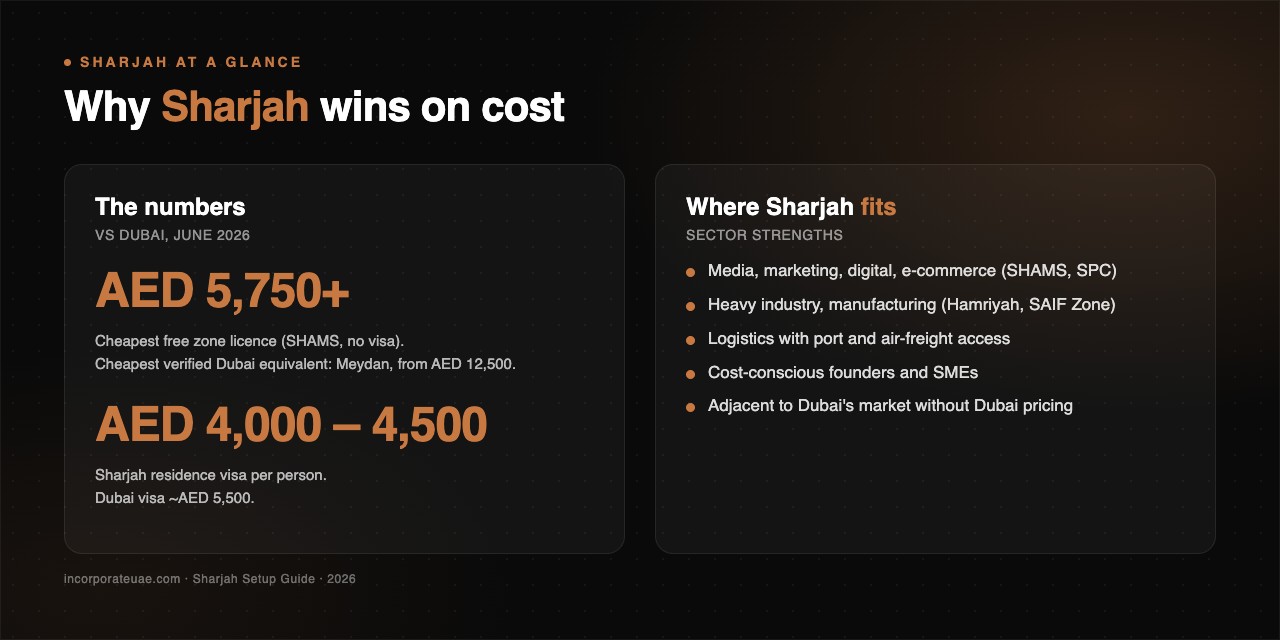
Sharjah is strong in three areas in particular: media and creative work, manufacturing and industry, and logistics. It has deep-water port access on two coasts and a long-established industrial base. The trade-off against Dubai is reach and prestige: Dubai offers a larger consumer market, more free zone choice, and stronger international banking relationships. If cost control is your priority, Sharjah usually wins. If market size or a Dubai address matters more, weigh the Dubai route against it.
Mainland or free zone in Sharjah?
Choose a SEDD mainland licence if you sell directly to customers inside the UAE, run a shop, cafe, or customer-facing service, or want unrestricted local trade. Choose a free zone if your revenue is mostly international, you want 100% foreign ownership with the lowest entry cost, or you do not need a physical retail presence.
A mainland company is licensed by SEDD, the Sharjah counterpart to Dubai's Department of Economy and Tourism. It can trade anywhere in the UAE, take on local clients directly, and bid for government work. Since the 2021 federal reforms, 100% foreign ownership is permitted for most mainland commercial and professional activities, so the old local-partner requirement no longer applies to the majority of businesses. The catch is that SEDD requires a physical, municipality-approved office with a registered lease. A flexi-desk does not satisfy a Sharjah mainland licence.
A free zone company is licensed by the free zone authority, allows 100% foreign ownership, and can usually operate from a flexi-desk that most UAE banks accept for opening an account. The limitation is market access. A Sharjah free zone company cannot sell directly into the UAE mainland market by default. It reaches local customers through a distributor or by taking a separate mainland licence.
One important difference from Dubai: Sharjah has no equivalent of the Dubai free zone mainland operating permit introduced in 2025. In Dubai, a free zone company can apply to trade on the mainland under a DET permit. In Sharjah, as of June 2026, that route does not exist. Plan your structure on the assumption that a Sharjah free zone licence is for international and in-zone business, not direct local retail.
The mainland versus free zone comparison sets the trade-offs side by side for your activity.
Sharjah's free zones: which one fits your business?
Sharjah has four main free zone authorities, each aimed at a different type of business. Picking the wrong one is a common and avoidable cost, because each has its own activity list, office model, and visa rules.
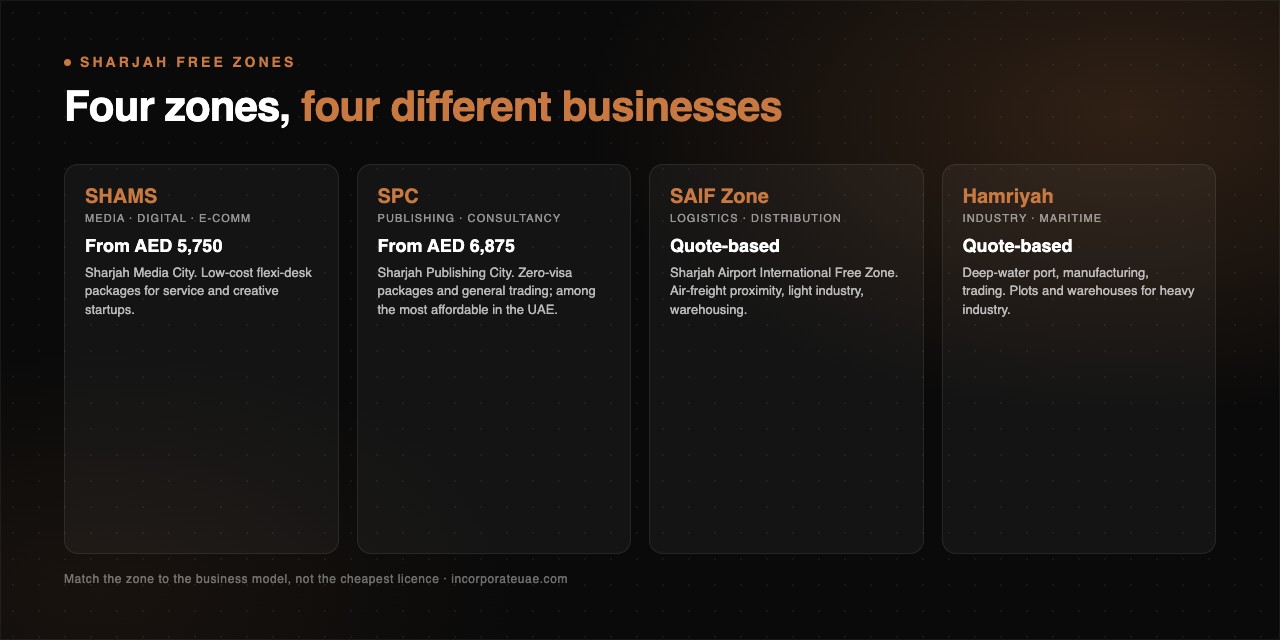
| Free zone | Built for | Indicative starting cost (2026) |
|---|---|---|
| SHAMS (Sharjah Media City) | Media, marketing, digital, IT, creative and e-commerce. Low-cost flexi-desk packages. | From around AED 5,750 (licence-only, no visa) |
| SPC (Sharjah Publishing City) | Publishing, general trading, consultancy. Zero-visa and affordable packages. | From around AED 6,875 |
| SAIF Zone (Sharjah Airport International Free Zone) | Logistics, distribution, light industry needing air-freight access. | Higher, industrial-focused; warehouse units available |
| Hamriyah Free Zone (HFZA) | Heavy industry, manufacturing, maritime and trading. Deep-water port and warehousing. | Higher, industrial-focused; plots and warehouses available |
A practical read: SHAMS and SPC are where most service businesses, freelancers, consultants, and e-commerce founders start, because of the flexi-desk packages and low entry cost. SAIF Zone and Hamriyah are for businesses that need physical industrial space, warehousing, or port and airport proximity, where the higher cost buys infrastructure you actually use. If you are unsure, the zone picker tool narrows it down by activity.
SHAMS packages include a compliant flexi-desk by default, which UAE banks accept for opening a corporate account. If you need a larger visa quota, a dedicated office is the upgrade.
How to set up a business in Sharjah: step by step
The process is largely digital in 2026. The free zone and mainland routes share the same shape, with the address requirement being the main divergence.
- Define your activity. Choose your business activity from the SEDD or free zone activity list. This drives the licence type (commercial, professional, industrial, or tourism) and any external approvals. One licence can cover multiple related activities.
- Choose your jurisdiction and legal structure. Decide between SEDD mainland and a free zone, then pick the entity type: an LLC or sole establishment on the mainland, or a Free Zone Establishment (single shareholder) or Free Zone Company (multiple shareholders) in a free zone.
- Reserve your trade name and get initial approval. Reserve a compliant name through the SEDD portal (sedd.ae) or the free zone portal. The authority checks the name is unique and your activity is permitted, usually within 24 to 48 hours.
- Sign the documents and secure an address. Mainland LLCs sign a notarised Memorandum of Association and must hold a municipality-approved office lease. Free zone companies sign the authority's standard documents and can take a flexi-desk.
- Pay the fee and collect your licence. Once checks clear, pay and receive your trade licence. At SPC and other free zones, a licence-only setup can be issued in around three working days, sometimes faster.
- Apply for visas, Emirates ID, and a bank account. Apply for residence visas, complete medical screening and Emirates ID, and open a corporate account.
Speed note: SEDD introduced an instant licence service for eligible office-based professional and commercial activities, with issuance in as little as one working day after documents are submitted. It does not cover industrial, food, or health activities that need an on-site inspection or ministry approval. A standard mainland setup that needs external approvals can take four to six weeks.
How much does business setup in Sharjah cost in 2026?
First-year costs range from roughly AED 5,750 for a no-visa free zone licence to AED 60,000 or more for a mainland company with an office and several visas. As with anywhere in the UAE, the headline licence price is not the full cost. Budget across four separate pillars and keep them apart when comparing quotes.
| Cost pillar | What it covers | Typical Sharjah range (2026) |
|---|---|---|
| Licence and government fees | Registration, initial approval, trade licence | AED 5,750 to AED 20,000+ depending on route and activity |
| Office or address | Flexi-desk (free zone) or a municipality-approved office (mainland) | Flexi-desk from low thousands; mainland office required, priced on space |
| Visa and Emirates ID | Entry permit, medical, Emirates ID, residency stamping, per person | Around AED 4,000 to AED 4,500 per person |
| Professional or agency fee | Optional document handling and support | AED 5,000 to AED 12,000 if you use an advisor |
Setting the two routes side by side:
| Setup type | First-year range (2026) | Notes |
|---|---|---|
| Sharjah free zone (SHAMS, SPC) | AED 5,750 to AED 25,000+ | Flexi-desk accepted; lowest entry cost in the UAE |
| Sharjah mainland (SEDD) | AED 25,000 to AED 60,000 | Physical office required; no flexi-desk; direct UAE market access |
A general trading licence on the Sharjah mainland commonly falls in the AED 15,000 to AED 30,000 range for licensing, and renewal is often calculated as a percentage of your office rent with a minimum fee, so your recurring cost is tied to the space you lease. Treat any single quoted figure with caution until you know which pillars it includes. Model your own number with the setup cost estimator.
Visas and office space
Sharjah visa costs are among the lowest in the UAE, at roughly AED 4,000 to AED 4,500 per person all-in, covering the entry permit, medical, Emirates ID, and residency stamping. The number of visas you can sponsor differs by route. On the mainland, the quota is typically linked to office size, often calculated at around one visa per 100 square feet of approved office space. In a free zone, the quota is fixed by your package tier regardless of desk size, which is why a SHAMS or SPC flexi-desk package suits founders who need only one or two visas.
For a mainland licence you need a registered office lease approved by the municipality. A flexi-desk is not accepted for SEDD licensing. In the free zones, the flexi-desk that comes with most packages is enough to open a bank account and sponsor your initial visas.
What taxes will a Sharjah business pay?
A Sharjah business pays the same federal taxes as anywhere in the UAE: 9% corporate tax on annual taxable profit above AED 375,000, 0% below it, and 5% VAT on most goods and services. There is no personal income tax, and the emirate has no separate local corporate tax.
A Sharjah free zone company can pay 0% corporate tax on qualifying income only if it meets all five Qualifying Free Zone Person conditions, including adequate substance and the de minimis test. Income from mainland UAE customers is generally non-qualifying and taxed at 9%. Separately, any UAE-resident business with revenue at or below AED 3 million can elect Small Business Relief and pay zero corporate tax, but only for tax periods ending on or before 31 December 2026, after which the relief ends. VAT registration is mandatory once taxable supplies pass AED 375,000 a year. The full mechanics are in our corporate tax guide and the UAE setup guide.
Documents you need
- Passport copies for all shareholders, directors, and the manager, valid for at least six months.
- Passport-size photographs.
- The signed Memorandum of Association for a mainland LLC, notarised where required.
- A municipality-approved tenancy contract for a mainland licence, or the free zone flexi-desk or office agreement.
- Entry permit or residence visa copies for any shareholder who already holds UAE residency.
- A no-objection certificate where an existing UAE resident needs one from a current sponsor.
- Sector-specific approvals where your activity is regulated.
Foreign corporate documents usually need attestation, either an apostille if your country is a Hague Convention member or legalisation through the UAE embassy and the Ministry of Foreign Affairs. Start this early, because document inconsistencies are the most common cause of delays.
Common mistakes to avoid
- Picking a free zone for a local-customer business. Without a Sharjah mainland licence, you cannot sell directly into the UAE market, and Sharjah has no Dubai-style mainland permit to fall back on.
- Reading a licence-only price as the full cost. A AED 5,750 figure is the licence with no visa and a flexi-desk. Add visas and an office and the real first-year number is higher.
- Choosing the wrong free zone for your activity. SHAMS and SPC suit service and media businesses; SAIF and Hamriyah suit industry and logistics. Matching the zone to the activity avoids paying for infrastructure you do not need.
- Assuming free zone means tax-free. It is 0% only on qualifying income and only if all QFZP conditions are met.
If you are at the start of the decision, the start-here guide sequences these choices in order.
Frequently asked questions
How much does it cost to set up a business in Sharjah? A no-visa Sharjah free zone licence starts from around AED 5,750. A free zone setup with an office and visas commonly reaches AED 25,000 or more, and a mainland company through SEDD typically runs AED 25,000 to AED 60,000 in the first year, depending on activity, office, and visa count.
Which is the cheapest free zone in Sharjah? SHAMS (Sharjah Media City) and SPC (Sharjah Publishing City) are the most affordable, with licence-only packages from around AED 5,750 and AED 6,875 respectively. Both suit service, media, digital, and e-commerce businesses and include a flexi-desk.
Can a Sharjah free zone company sell to customers in the UAE mainland? Not directly. A Sharjah free zone company reaches the local UAE market through a distributor or by taking a separate mainland licence. Unlike Dubai, Sharjah has no free zone mainland operating permit as of June 2026.
Is Sharjah cheaper than Dubai for business setup? Yes. Sharjah free zone licences start lower (around AED 5,750 against roughly AED 12,500 for Meydan's standard Dubai licence), office space costs less, and Sharjah visas run around AED 4,000 to AED 4,500 against about AED 5,500 in Dubai.
How long does it take to set up a business in Sharjah? A free zone licence can be ready in about three working days. SEDD's instant licence service issues eligible office-based mainland licences in as little as one working day, while a standard mainland setup needing external approvals can take four to six weeks.
Sources
UAE Government portal (u.ae), Sharjah Economic Development Department (SEDD), Sharjah free zone authorities (SHAMS, SPC, SAIF Zone, Hamriyah), Federal Tax Authority guidance, and cross-checked against independent setup providers. Fees and rules are current as of June 2026 and change periodically; confirm figures with the relevant authority before you commit. Last checked: 19 June 2026.
This article is educational content, not legal or tax advice. For advice on your specific situation, consult a licensed adviser. Ready to price your own setup? Use the cost estimator for an itemised snapshot.