Setting up a business in the UAE comes down to one core decision and roughly seven administrative steps. The decision is jurisdiction: a mainland licence issued by the emirate's economic department, or a free zone licence issued by one of the country's 40-plus free zone authorities. The steps, from choosing your activity to collecting your trade licence, are broadly the same either way, and most can now be completed online.
This guide covers the full 2026 process. It explains how mainland and free zone setup differ after the rule changes that took effect in 2025, what each route costs in Dubai and in Sharjah, the documents you need, realistic timelines, and the corporate tax and VAT position you inherit the day your licence is issued. Figures are current as of June 2026 and the sources are listed at the end.
How do you set up a business in the UAE?
You set up a business in the UAE by choosing a business activity, selecting a jurisdiction (mainland or free zone) and an emirate, reserving a trade name, obtaining initial approval, signing the incorporation documents, securing an office or flexi-desk address, and paying the licence fee to receive your trade licence. Residence visas and a corporate bank account follow once the licence is issued.
In brief, the sequence is:
- Define your business activity.
- Choose the jurisdiction and emirate (mainland or free zone).
- Choose your legal structure.
- Reserve your trade name and get initial approval.
- Sign the Memorandum of Association and lease an address.
- Pay the fee and collect your trade licence.
- Apply for residence visas, Emirates ID, and a corporate bank account.
Each step is covered in detail below. First, the decision that shapes everything that follows.
Mainland or free zone: which structure is right for you?
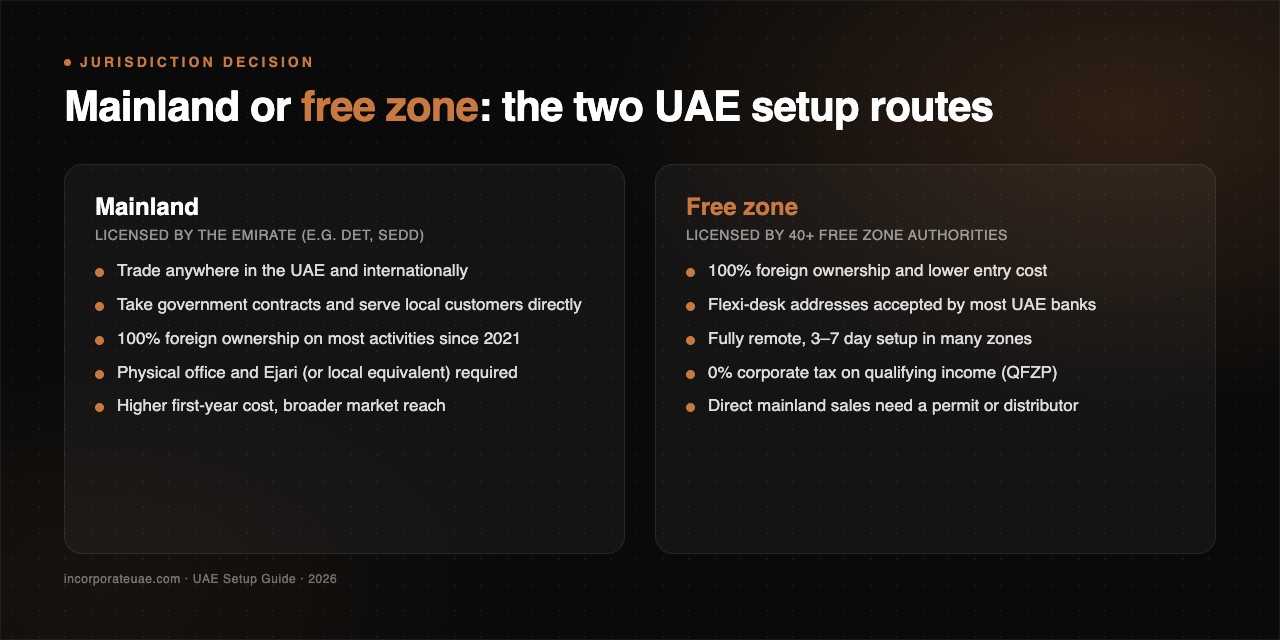
Choose mainland if you sell directly to customers inside the UAE, want to bid for government contracts, or run a retail, food, or hospitality operation. Choose a free zone if your revenue is mostly international, you want the lowest entry cost, or you need a fast, remote setup. This is the single most important choice you will make, because it determines where you can trade, who regulates you, and how your tax position is assessed.
A mainland company is licensed by the emirate's Department of Economic Development (in Dubai, the function sits with the Department of Economy and Tourism, the DET). A mainland licence lets you trade anywhere in the UAE and internationally, take government work, and hold an unrestricted visa quota tied to office size. Since the 2021 reforms extended 100% foreign ownership to most mainland activities, the old requirement for a 51% local partner no longer applies to the majority of commercial and professional activities, so the practical gap between mainland and free zone has narrowed.
A free zone company is licensed by the free zone authority and is built for international trade, services, and online businesses. The draws are 100% foreign ownership, low-cost packages, flexi-desk addresses that satisfy banking requirements, and remote registration. The historic limitation is that a free zone licence does not, by default, let you sell directly into the UAE mainland market. You either appoint a mainland distributor or obtain a mainland presence. That limitation changed in Dubai in 2025, and the detail matters.
What changed in 2026: the free zone mainland operating permit
Dubai now lets most free zone companies operate on the mainland without setting up a separate mainland entity. Under Executive Council Resolution No. 11 of 2025, which took effect on 3 March 2025, a Dubai free zone company (financial firms in the DIFC are excluded) can apply to the DET for either a branch licence or a temporary permit and trade in mainland Dubai under that authorisation. The published annual fees are AED 10,000 for a branch licence and AED 5,000 for a temporary permit, which is valid for up to six months. The DET issues the list of activities each company is allowed to perform, so confirm your specific activity is eligible before relying on this route.
Two honest caveats sit alongside that change:
- It is Dubai-specific. Abu Dhabi has its own framework allowing out-of-emirate firms to open branches without first-year physical premises, but Sharjah has no equivalent published permit as of June 2026. A Sharjah free zone company still reaches the mainland market through a distributor or a separate mainland licence.
- Regulatory permission and tax treatment are separate questions. Getting a permit to serve mainland customers does not make that income tax-free. Mainland-customer income is generally non-qualifying for a free zone company, which affects its 0% corporate tax status. See the tax section below.
The 2025 reform removes a structural reason to choose mainland over free zone in Dubai. It does not remove the tax reason. Treat the licensing decision and the tax decision as two separate calculations.
If you are weighing the two routes against your specific activity, the mainland versus free zone comparison sets the options side by side.
How to set up a business in the UAE: the step-by-step process
The process below applies to both routes. Where mainland and free zone diverge, that is flagged.
Step 1: Define your business activity
Start with the exact activity, because it drives everything else: the licence type, the approvals you need, and where you can register. UAE authorities publish activity lists grouped into commercial (trading), professional (services), and industrial (manufacturing) categories, with hundreds of sub-activities beneath them. Some activities need approval from a federal ministry or regulator before licensing, for example food trading, healthcare, and financial services. Pick the sub-activities that match what you will actually do, and check the approved activities list for restrictions tied to yours.
Step 2: Choose the jurisdiction and emirate
Decide between mainland and a free zone using the test in the section above, then pick the emirate. Dubai offers the deepest market and the widest free zone choice. Sharjah is the most cost-competitive of the three covered here. Abu Dhabi, the northern emirates, and specialist financial centres (DIFC, ADGM) are alternatives beyond this guide's scope. If you are unsure which free zone fits your activity, the zone picker tool narrows it down by sector.
Step 3: Choose your legal structure
Select the entity type. The common options are a limited liability company (LLC) for mainland trading and services, a Free Zone Establishment (FZE) for a single shareholder, and a Free Zone Company (FZCO) for multiple shareholders. Branch offices of an existing UAE or foreign company are also available. Your structure determines shareholder rules, visa allocation, and the documents you sign at incorporation.
Step 4: Reserve your trade name and get initial approval
Reserve a compliant trade name, then secure initial approval from the licensing authority. The name must follow UAE naming rules: no offensive or religious terms, no abbreviations of personal names, and the legal form (LLC, FZE) appended. Initial approval is the authority's confirmation that it has no objection to you starting the business. On the mainland you typically have a fixed window, around 30 days, to pay the licence fee after approval, or the application lapses.
Step 5: Sign the Memorandum of Association and lease an address
Prepare and sign the incorporation documents and secure your registered address. Mainland LLCs sign a Memorandum of Association (often a notarised bilingual document) and must hold a physical office with a registered tenancy contract. In Dubai that registration is an Ejari; in Sharjah the SEDD requires a municipality-approved lease and does not accept a flexi-desk for a mainland licence. Free zone companies sign the authority's standard documents and can usually take a flexi-desk, which most UAE banks accept for opening an account. The office and Ejari requirements differ by activity and headcount.
Step 6: Pay the fee and collect your trade licence
Submit your final documents, pay the licence fee, and receive your trade licence, the legal authorisation to operate. At this point the company exists. The mainland licensing route sets out the document checklist for DET and SEDD applications.
Step 7: Apply for visas, Emirates ID, and a bank account
Apply for residence visas, complete medical screening and Emirates ID, and open a corporate bank account. Your licence unlocks an establishment card and a visa quota. Each residence visa runs through an entry permit, a medical fitness test, Emirates ID registration, and residency stamping. The residence visa guide covers eligibility and dependants. Bank account opening is the step most founders underestimate; budget two to four weeks and expect enhanced due diligence on foreign-owned companies. Our guide to opening a UAE business bank account as a foreigner explains the documents and the common rejection reasons.
How much does business setup cost in the UAE in 2026?
First-year setup costs range from roughly AED 6,000 for a no-visa Sharjah free zone licence to AED 75,000 or more for a Dubai mainland LLC with an office and a visa. The spread is wide because the headline "licence cost" you see advertised rarely includes the office, the visas, or the agency fee. The single biggest mistake in budgeting is reading a bundled agency package price as if it were the government fee. They are different numbers measuring different things.
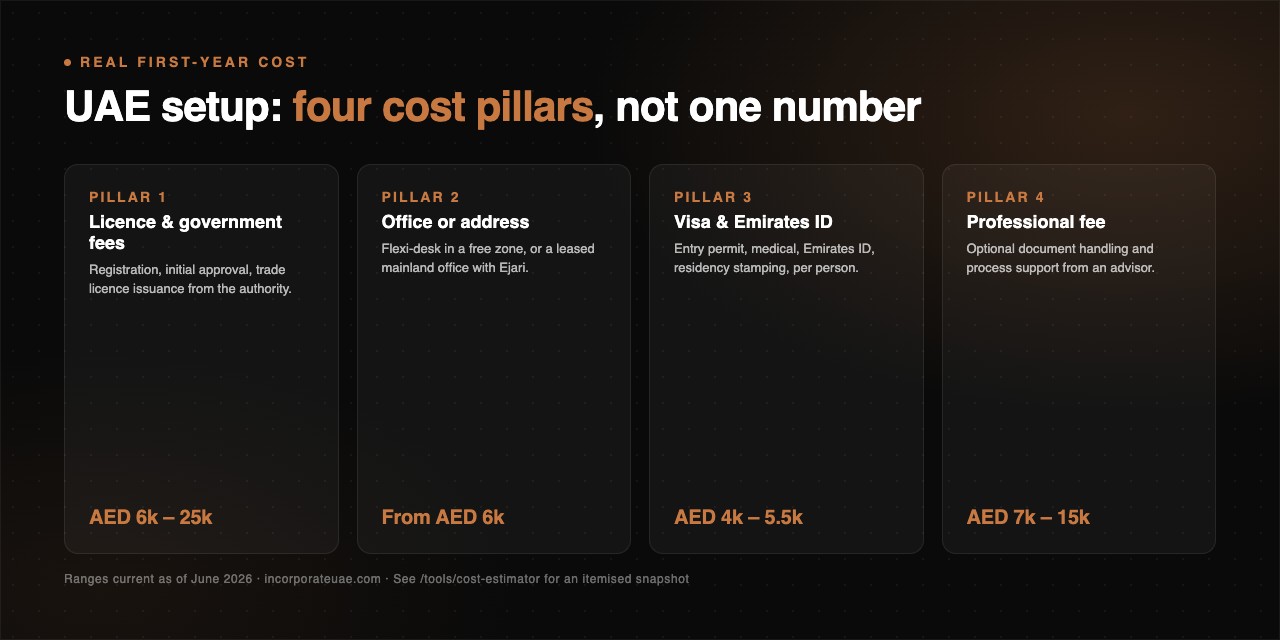
A realistic first-year budget has four separate pillars. Keep them separate when you compare quotes:
| Cost pillar | What it covers | Typical 2026 range |
|---|---|---|
| Licence and government fees | Registration, initial approval, trade licence issuance | AED 6,000 to AED 25,000, depending on route and emirate |
| Office or address | Flexi-desk in a free zone, or a leased mainland office (Ejari) | From under AED 6,000 for a flexi-desk to far higher for a dedicated office |
| Visa and Emirates ID | Entry permit, medical, Emirates ID, residency stamping, per person | AED 4,000 to AED 5,500 per person |
| Professional or agency fee | Optional document handling and process support | AED 7,000 to AED 15,000 if you use an advisor |
You can model your own figure with the setup cost estimator, which itemises these pillars rather than quoting one blended number.
Business setup in Dubai: cost
Dubai mainland setup for a single-owner LLC commonly runs AED 35,000 to AED 75,000 in the first year, including a basic office arrangement and one investor visa. Of that, government and licence fees usually account for AED 15,000 to AED 25,000, with the remainder split across office, visas, and any professional fees. Dubai free zone packages vary widely by authority and visa count, and commonly fall between AED 12,500 and AED 30,000 for a first-year package that includes a flexi-desk. A Dubai mainland visa runs around AED 5,500 per person, the highest of the three jurisdictions here.
Business setup in Sharjah: cost
Sharjah is the cheapest of the three. A free zone licence starts at around AED 5,750 to AED 9,000 for a no-visa package in zones such as Sharjah Media City (SHAMS) or Sharjah Publishing City (SPC), with SPC licences quoted from around AED 6,875. Add a physical office and several visas and the figure climbs toward AED 25,000 or more. Sharjah mainland setup through the Sharjah Economic Development Department (SEDD) typically runs AED 25,000 to AED 60,000. The cost advantage is structural: Sharjah office space is markedly cheaper than Dubai, and a Sharjah visa runs around AED 4,000 to AED 4,500 per person against Dubai's AED 5,500.
| Setup type | First-year range (2026) | Notes |
|---|---|---|
| Sharjah free zone (SHAMS, SPC) | AED 5,750 to AED 25,000+ | Flexi-desk accepted; lowest entry cost |
| Sharjah mainland (SEDD) | AED 25,000 to AED 60,000 | Physical office required, no flexi-desk |
| Dubai free zone | AED 12,500 to AED 30,000+ | Package-dependent; flexi-desk accepted |
| Dubai mainland | AED 35,000 to AED 75,000 | Office plus one investor visa |
These are indicative ranges. The exact figure depends on your activity, visa count, office choice, and whether you use an advisor. Treat any single quoted number with suspicion until you know which of the four pillars it includes.
Business setup in Dubai
Dubai suits founders who want the deepest local market and the broadest free zone choice. The DET licenses mainland companies, and the emirate hosts more than 20 free zones, from DMCC for commodities and general trading to Dubai Internet City, Dubai Media City, and the airport free zones. The 2025 free zone mainland operating permit (covered above) makes Dubai the only emirate where a free zone company can serve mainland customers under a DET permit rather than a separate entity, which narrows the historic reason to default to a mainland licence. If your customers are in Dubai or you need government contracts, mainland is still the cleaner route. If your revenue is international and you want speed and lower cost, a Dubai free zone is the leaner first step. For zone-by-zone costs, the new mainland permit, and the bank account step in detail, read our Dubai business setup guide.
Business setup in Sharjah
Sharjah suits cost-conscious founders, media and creative businesses, and industrial or logistics operations. The emirate pairs a competitively priced mainland (SEDD) with several free zones aimed at different sectors:
- SHAMS (Sharjah Media City): low-cost packages and flexi-desks, popular with media, digital, and e-commerce startups.
- SPC (Sharjah Publishing City): among the most affordable zones, with zero-visa and general-trading options.
- Hamriyah Free Zone: a deep-water port and warehousing, built for industry, trading, and maritime.
- SAIF Zone (Sharjah Airport International Free Zone): proximity to air freight, suited to logistics and distribution.
The trade-off is market access. A Sharjah free zone company reaches the wider UAE market through a distributor or a separate mainland licence, because Sharjah has no Dubai-style mainland operating permit as of June 2026. For a retail shop, cafe, or customer-facing service in Sharjah, a SEDD mainland licence is the required structure. For zone-by-zone costs, the SEDD instant-licence option, and the full Sharjah process, read our Sharjah business setup guide.
What taxes will your UAE business pay?
A UAE business pays 9% corporate tax on annual taxable profit above AED 375,000, 0% below that, and 5% VAT on most goods and services. There is no personal income tax. Two reliefs can reduce the corporate tax bill to zero, and both have conditions.
Corporate tax (9%). The UAE introduced federal corporate tax for financial years starting on or after 1 June 2023, under Federal Decree-Law No. 47 of 2022. The first AED 375,000 of taxable income is taxed at 0%, and the portion above at 9%. This is a graduated rate inside a single return, not a personal-style allowance. Returns are filed through the Federal Tax Authority's EmaraTax portal within nine months of the financial year end. Most exempt or zero-rated businesses still have to register and file.
Free zone 0% rate (QFZP). A free zone company is not automatically tax-free. It pays 0% only on qualifying income, and only if it meets all five Qualifying Free Zone Person conditions: adequate substance in the zone, qualifying income, the de minimis test, no election into the standard regime, and arm's length transfer pricing. Income from mainland UAE customers is generally non-qualifying and taxed at 9%. If non-qualifying revenue exceeds the lower of AED 5 million or 5% of total revenue, the company can lose QFZP status for that period and the following four. This is the tax cost that sits behind the Dubai mainland operating permit: serving mainland customers can move income out of the 0% band.
Small Business Relief (SBR). A UAE-resident business with revenue at or below AED 3 million can elect to be treated as having no taxable income, paying zero corporate tax. It is a transitional relief available only for tax periods ending on or before 31 December 2026, and no extension has been announced. It must be actively elected in the EmaraTax return, it is not automatic, and a business cannot combine SBR with QFZP in the same period. For a service business under AED 3 million in revenue, SBR is usually simpler and worth more than the free zone route, but it expires soon, so model your 2027 position now.
VAT (5%). VAT registration is mandatory once taxable supplies exceed AED 375,000 in a year and voluntary above AED 187,500. The standard rate is 5%, charged to customers and remitted to the FTA. The corporate tax and VAT pages cover registration thresholds and filing in detail.
The reliefs are real but time-limited. Small Business Relief ends with the 2026 tax periods. Decide your structure on the position that applies from 2027, not only on the relief available today.
How long does it take to set up a business in the UAE?
A free zone licence can be issued in three to seven working days, and some Dubai zones offer same-day or instant licences. A mainland licence usually takes two to four weeks, longer if your activity needs extra ministry approvals. Visas and bank accounts add time on top.
| Step | Free zone | Mainland |
|---|---|---|
| Trade licence | 1 to 7 working days (same-day options exist) | 2 to 4 weeks (6 to 8 weeks if extra approvals are needed) |
| Residence visa per person | 1 to 2 weeks | 1 to 2 weeks |
| Corporate bank account | 2 to 4 weeks | 2 to 4 weeks |
The licence is the fast part. The bank account is where foreign-owned companies most often stall, because of enhanced due diligence on ownership, activity, and source of funds.
Documents you need
Requirements vary slightly by authority, but the core set is consistent:
- Passport copies for all shareholders, directors, and the manager, valid for at least six months.
- Passport-size photographs.
- Proof of address and, where requested, a CV or a brief business plan.
- Entry permit or residence visa copies for shareholders who already hold UAE residency.
- The signed Memorandum of Association (mainland LLC), notarised and bilingual where required.
- A registered tenancy contract: an Ejari in Dubai, or a municipality-approved lease in Sharjah for a mainland licence.
- Sector-specific approvals where your activity is regulated.
- For a branch of an existing company: parent company documents, a board resolution, and attested corporate records.
Foreign corporate documents usually need attestation, either an apostille if your country is a Hague Convention member or legalisation through the UAE embassy and the Ministry of Foreign Affairs. Start attestation early, because it can take several weeks and document inconsistencies are the leading cause of bank rejections.
Common mistakes to avoid
- Reading a bundled package price as the government fee. Always separate licence, office, visa, and agency costs before you compare quotes.
- Assuming a free zone licence is tax-free. It is 0% only on qualifying income and only if all QFZP conditions are met.
- Choosing a free zone for a mainland-customer business outside Dubai. Without the Dubai permit, you will need a distributor or a separate mainland licence to sell locally.
- Leaving the bank account to the end. Choose your bank and prepare its documents while the licence is processing, not after.
- Banking on Small Business Relief past 2026. Plan your structure on the rules that apply from 2027.
If you are at the very start, the start-here guide sequences these decisions in order.
Frequently asked questions
Can a foreigner own 100% of a UAE business? Yes. Free zones have always allowed 100% foreign ownership, and the 2021 reforms extended it to most mainland commercial and professional activities, removing the old 51% local partner requirement for the majority of business types. A small set of strategic activities still has ownership conditions.
Is it cheaper to set up in Dubai or Sharjah? Sharjah is cheaper. A no-visa Sharjah free zone licence starts from around AED 5,750, against roughly AED 12,500 and up for a Dubai free zone package, and Sharjah visas and office space both cost less. Dubai offers a larger market and more free zone choice in return for the higher cost.
Do I need to be in the UAE to set up a company? Not for the licence. Most free zones allow fully remote registration. You will usually need to visit for biometrics and Emirates ID, and many banks require an in-person or video meeting before opening a corporate account.
Can a free zone company sell to customers in the UAE mainland? In Dubai, yes, since 2025, by obtaining a DET branch licence or temporary permit under Resolution No. 11 of 2025. Elsewhere, including Sharjah, a free zone company reaches the mainland market through a distributor or a separate mainland licence.
How much corporate tax will my UAE business pay? 0% on the first AED 375,000 of annual taxable profit and 9% above it. A free zone company can pay 0% on qualifying income if it meets all QFZP conditions, and any UAE-resident business under AED 3 million in revenue can elect Small Business Relief to pay zero, for tax periods ending on or before 31 December 2026.
How long does the whole process take? A free zone licence can be ready in a few working days; a mainland licence typically takes two to four weeks. Add one to two weeks per visa and two to four weeks for a corporate bank account.
Sources
UAE Government portal (u.ae), Federal Tax Authority guidance and Federal Decree-Law No. 47 of 2022, Dubai Executive Council Resolution No. 11 of 2025 (effective 3 March 2025), Department of Economy and Tourism (DET), Sharjah Economic Development Department (SEDD), and cross-checked against independent setup providers and legal advisories. Fees and rules are current as of June 2026 and change periodically; confirm figures with the relevant authority before you commit. Last checked: 19 June 2026.
This article is educational content, not legal or tax advice. For advice on your specific situation, consult a licensed adviser. Ready to price your own setup? Use the cost estimator for an itemised snapshot.